A Comparison of Online, Blended, and Flipped Environments
- Allison Perez

- Jun 20, 2025
- 2 min read
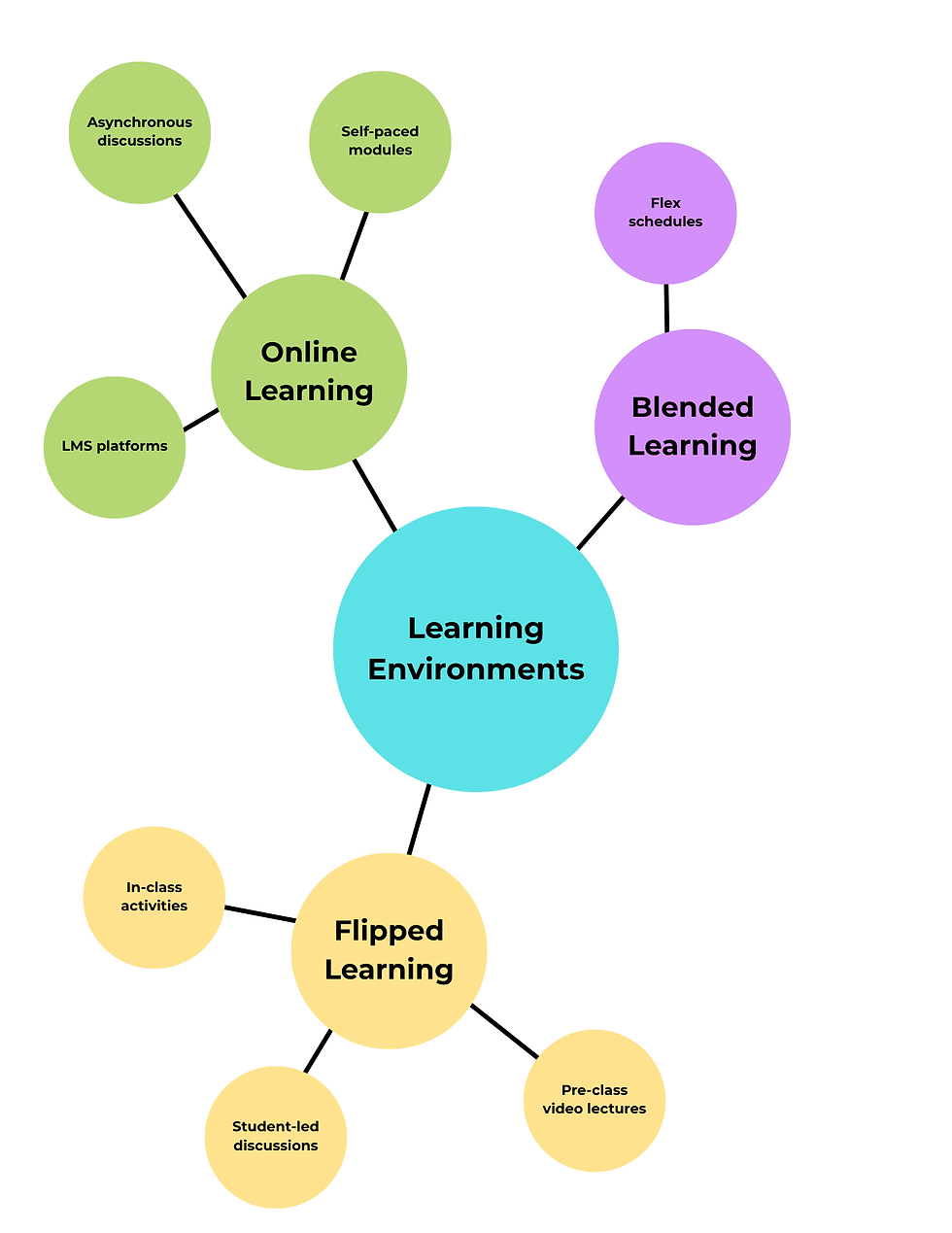
In today’s world, learning doesn’t always happen in a traditional classroom. There are many options now that give learners and educators more flexibility, especially with the help of technology. There are three types of learning environments that are widely used: online learning, blended learning, and flipped learning. These models all use digital tools in different ways, and each one has its own strengths and situations where it works best. Figure 1 shows each learning type and sample activities that exemplify each learning type.
Online learning takes place entirely through the internet. There’s no face-to-face time unless it’s scheduled through video calls. Most of the time, students work at their own pace, watching recorded lectures, participating in discussion forums, and completing assignments on a learning platform like Canvas or Moodle. One of the biggest benefits of online learning is flexibility. It works well for students who have jobs, families, or live far from a physical school. The challenge, though, is that students have to stay motivated and manage their time well. Without in-person support, it’s easy to fall behind (U.S. Department of Education, 2010).
Blended learning mixes online and in-person instruction. For example, students might come to class a couple of times a week and then do the rest of their work online. This setup gives the structure of face-to-face learning with the added flexibility of online content. Students can ask questions in person and then go back and review materials online if needed. Blended learning is helpful for making lessons more interactive and reaching different learning styles. Teachers can use the classroom time for discussions, group work, or hands-on activities, while still giving students access to digital resources at home (Educause, 2020).
Flipped learning is different because the “lecture” part of class happens at home and the “homework” is done in class. Students might watch a video or read an article before coming to class. Then, when they show up, they work through problems or projects with help from the teacher. This allows more time for active learning in the classroom and can help students understand the material better. It also gives the teacher a chance to see where students are struggling and step in with support right away (Center for Teaching and Learning, 2023).
Each of these learning environments can be effective when used in the right context. Some students do well with the independence of online learning, while others benefit from the structure of blended or flipped models. The key is to match the learning format to the goals of the course and the needs of the learners.
Figure 1
Mind Map of Online, Blended, and Flipped Learning Environments
References
Center for Teaching and Learning. (2023). Flipped classrooms. University of Texas at Austin.
Educause. (2020). 7 things you should know about blended learning. https://library.educause.
edu/resources/2020/5/7-things-you-should-know-about-blended-learning
U.S. Department of Education. (2010). Evaluation of evidence-based practices in online
learning: A meta-analysis and review of online learning studies. https://www2.ed.gov/rs
chstat/eval/tech/evidence-based-practices/finalreport.pdf

Comments